Publications & Press

Peer-reviewed papers, conference proceedings and invited talks across SiPM-based PET, image quality and radiotherapy applications.

EJNMMI Physics journal article page

Assessing small-lesion detectability and acquisition time optimisation in silicon-detector-based PET: a phantom study

Leybourne N, Prakash V, Hussein M, Fenwick A, Strouhal P, Evans P, Florescu L

10.1186/s40658-025-00821-9

Published in EJNMMI Physics, this phantom study assessed how silicon photomultiplier (SiPM) detector technology improves the detection of small lesions and enables shorter PET acquisition times. Using a modified NEMA IEC Body Phantom with additional sub-centimetre spheres, digital SiPM-based PET was compared with a conventional photomultiplier-tube (PMT) system. Lesions were detectable down to 4 mm in diameter, and an acquisition-time model linking lesion size and sphere-to-background ratio to scan duration demonstrated that comparable detectability could be maintained, with acquisition time reduced by between 1.6% and 89% depending on sphere size and uptake. The findings support shorter, tailored imaging protocols with potential benefits for patient throughput, comfort, and radiation exposure.

28 December 2025
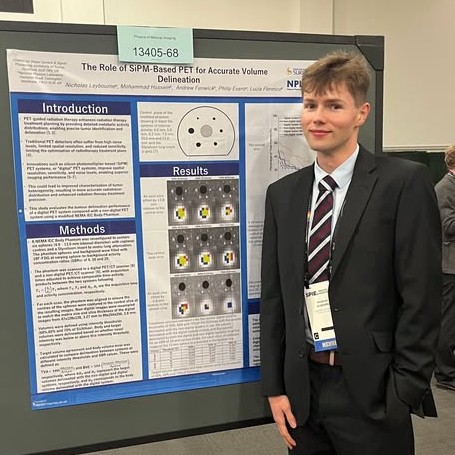
SiPM-based PET volume delineation poster

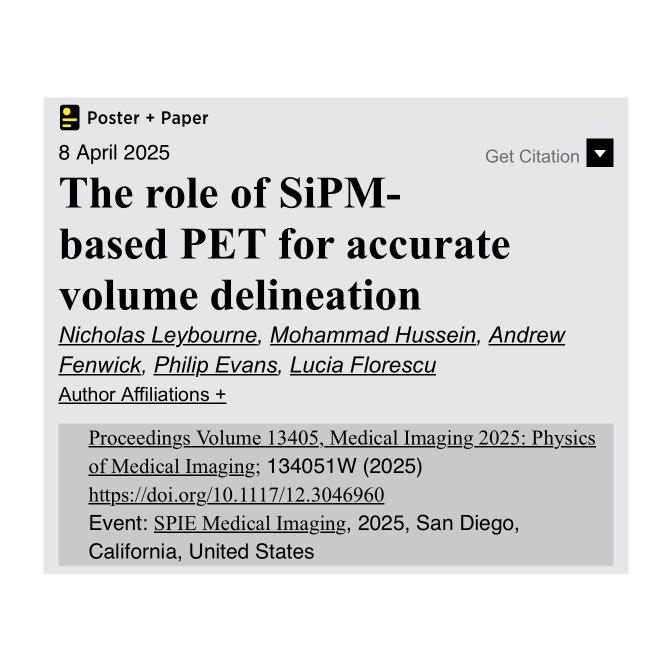
The role of SiPM-based PET for accurate volume delineation

Leybourne N, Hussein M, Fenwick A, Evans P, Florescu L

10.1117/12.3046960

This study investigated the efficacy of silicon photomultiplier (SiPM) PET systems in improving volume delineation for radiotherapy treatment planning. Using a modified NEMA IEC Body Phantom filled with fluorodeoxyglucose (18F-FDG), both digital SiPM-based and non-digital photomultiplier tube PET scanners were evaluated. Results showed that the digital SiPM system consistently delineated target volumes 1.91 to 3.56 times larger than the non-digital system. The digital system's target volumes (440mm³ to 984mm³) were closer to the true geometric volume of the spheres (2156mm³), compared to the non-digital system (209mm³ to 419mm³). These differences were most pronounced for higher sphere-to-background activity ratios and smaller structures. The study suggests that digital PET can improve cancer treatment planning, offering advantages for targeted radiation therapy.

April 2025
SPIE Medical Imaging Conference 2025

SPIE Medical Imaging Conference 2025, San Diego, USA

Attending the SPIE Medical Imaging Conference 2025 was a valuable experience for my career development. Presenting my work allowed me to showcase my research and receive constructive feedback, which helped me make significant progress. It also provided a unique opportunity to engage with other professionals in the field, learn about their work, and gain insights that expanded my knowledge and perspective.

February 2025
Digital PET small feature detection study

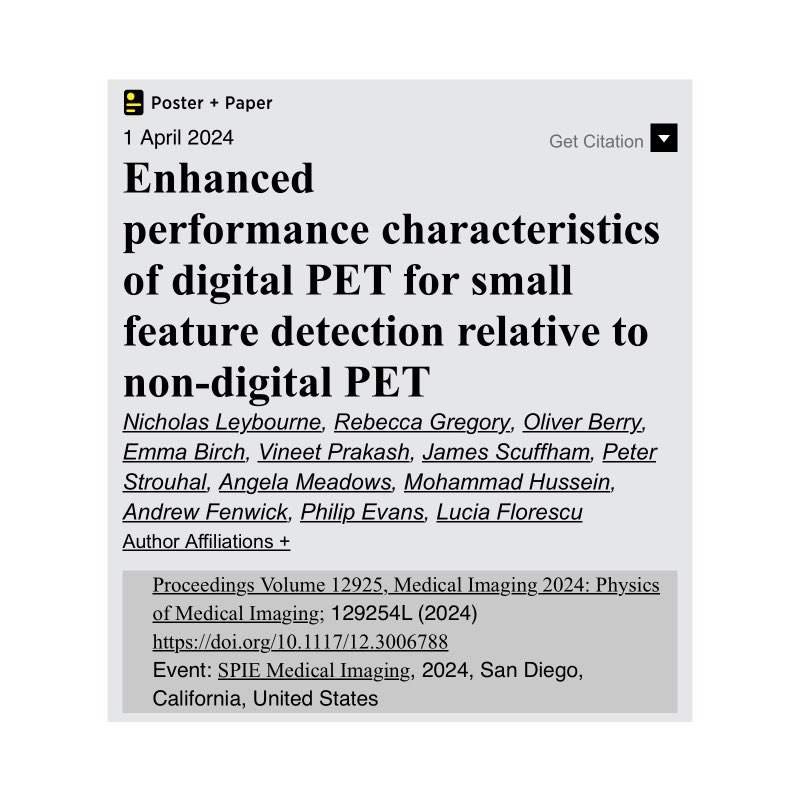
Enhanced performance characteristics of digital PET for small feature detection relative to non-digital PET

Leybourne N, Gregory R, Berry O, Scuffham J, Evans P, Florescu L, et al.

10.1117/12.3006788

This study investigated the performance of digital PET/CT systems in detecting smaller lesions using subcentimeter microsphere inserts in a NEMA IEC Body Phantom. The digital system was compared to a non-digital PET scanner with the same image reconstruction method. Results showed that the digital system had higher detectability for lesions under 7.9mm, with an average 1-point higher Likert score. Additionally, contrast recovery drop-off occurred at smaller microspheres in the digital system, suggesting that digital PET requires smaller spheres in image quality testing for accurate performance comparison. These findings highlight the superior imaging capabilities of digital PET, improving lesion visibility and detection.

April 2024
SPIE Medical Imaging Conference 2024

SPIE Medical Imaging Conference 2024, San Diego, USA

Presenting my poster at SPIE Medical Imaging 2024 provided a valuable platform to engage with experts in the field, whose constructive feedback contributed to the refinement of my methodology and interpretation of results. The experience facilitated critical reflection on my current work, highlighting areas for further exploration and improvement. Additionally, attending the conference allowed me to stay up to date of the latest developments, methodologies, and innovations in the discipline, and to engage in meaningful discussions with fellow researchers.

February 2024
CVSSP research seminar

Research Seminar Speaker, CVSSP

Image Quality and Clinical Potential of Novel Silicon-Based PET

This presentation examined the advantages of silicon-based PET compared to conventional systems. It outlined the principles of PET imaging using FDG as a positron-emitting tracer and described digital photon counter technology, which enables detection of individual photon events. Preliminary research was presented using modified NEMA phantoms with small spheres to investigate the feasibility of reduced scan times, lower radiation doses, improved diagnostic accuracy, and enhanced treatment planning. Potential applications in radiotherapy, including dose painting techniques, were also explored.

November 2023